Best Industries for Cloud ERP: Top 10 Sectors in 2025
Published July 10, 2025
The digital transformation landscape continues to evolve rapidly, with cloud-based Enterprise Resource Planning (ERP) systems becoming increasingly vital for businesses across diverse sectors. As we navigate through 2025, organizations are recognizing that cloud ERP solutions potentially offer enhanced scalability, improved security, and reduced operational costs compared to traditional on-premise systems.
Understanding which industries may benefit most from cloud ERP implementation is crucial for business leaders considering this technological shift. While every organization has unique requirements, specific sectors have demonstrated particularly strong adoption rates and success stories with cloud-hosted ERP solutions like QuickBooks Enterprise, Sage 100, Sage 300, and Sage Intacct.
What Makes an Industry Ideal for Cloud ERP?
Before exploring specific sectors, it’s essential to understand the characteristics that potentially make an industry well-suited for cloud ERP adoption. Sectors that could benefit most typically share several common traits:
Regulatory Compliance Requirements: Sectors with strict compliance needs often find cloud ERP systems valuable for maintaining audit trails, ensuring data security, and meeting industry-specific regulations.
Multi-Location Operations: Industries with distributed operations across multiple locations or regions may experience significant benefits from centralized, cloud-accessible ERP systems.
Real-Time Data Dependencies: Sectors requiring instant access to financial, operational, or inventory data could see substantial improvements in decision-making capabilities.
Scalability Needs: Industries experiencing rapid growth or seasonal fluctuations often require the flexibility that cloud ERP solutions can provide.
Top 10 Industries for Cloud ERP Implementation in 2025
1. Manufacturing and Production
The manufacturing sector continues to be one of the strongest candidates for cloud ERP adoption. Modern Cloud ERP solutions integrate AI, IoT, and automation, profoundly enhancing efficiency and decision-making within manufacturing environments.
Manufacturing companies potentially benefit from cloud ERP through improved supply chain visibility, real-time production monitoring, and enhanced quality control processes. The ability to access critical manufacturing data from anywhere becomes particularly valuable for companies with multiple production facilities or remote management teams.
Key Benefits for Manufacturing:
Enhanced inventory management and demand forecasting
Streamlined production planning and scheduling
Improved supplier relationship management
Real-time quality control and compliance tracking
2. Professional Services
Professional services firms, including consulting, accounting, and legal practices, represent another sector where cloud ERP solutions may deliver exceptional value. These organizations often require project-based accounting, time tracking, and resource allocation capabilities that cloud ERP systems can provide effectively.
Providing secure and reliable fully-managed cloud-based ERP solutions for customers in the professional and business services sector since 2005, companies like gotomyerp have developed specialized expertise in serving this market segment.
Key Benefits for Professional Services:
Project-based financial tracking and profitability analysis
Enhanced time and expense management
Improved client billing and invoicing processes
Better resource allocation and capacity planning
3. Healthcare and Medical Services
The healthcare industry faces unique challenges regarding data security, regulatory compliance, and operational efficiency. Cloud ERP systems potentially offer healthcare organizations the tools needed to manage complex financial operations while maintaining strict compliance with regulations like HIPAA.
Healthcare providers may find particular value in cloud ERP solutions that integrate with existing medical management systems, enabling comprehensive financial oversight alongside clinical operations.
Key Benefits for Healthcare:
Enhanced patient billing and insurance claim processing
Improved inventory management for medical supplies
Streamlined compliance reporting and audit preparation
Better integration with electronic health record systems
4. Distribution and Wholesale
Distribution companies often operate with complex supply chains, multiple warehouses, and extensive inventory management requirements. Cloud ERP solutions can potentially provide the real-time visibility and control these organizations need to optimize their operations.
53% of businesses prioritize ERP investments in 2025, particularly in manufacturing and distribution sectors, indicating strong continued growth in this area.
Key Benefits for Distribution:
Advanced inventory tracking and warehouse management
Improved demand forecasting and procurement planning
Enhanced supplier and customer relationship management
Better logistics and shipping coordination
5. Construction and Real Estate
The construction industry presents unique project-based accounting challenges, with multiple job sites, varying project timelines, and complex cost tracking requirements. Cloud ERP systems may offer construction companies the flexibility and visibility needed to manage these complexities effectively.
Real estate organizations similarly benefit from project-based financial tracking, property management capabilities, and integration with specialized real estate applications.
Key Benefits for Construction and Real Estate:
Project-based cost tracking and profitability analysis
Enhanced job costing and change order management
Improved cash flow forecasting and management
Better compliance with industry-specific regulations
6. Government and Public Sector
SOC-certified, compliant cloud hosting services for government ERP solutions have become increasingly important as public sector organizations modernize their operations. Government agencies may benefit from cloud ERP solutions that meet strict security and compliance requirements while providing enhanced transparency and accountability.
Key Benefits for Government:
Enhanced budget tracking and financial transparency
Improved grant management and reporting
Better compliance with government accounting standards
Streamlined procurement and vendor management processes
7. Technology and Software
Technology companies often experience rapid growth, complex revenue recognition requirements, and a need for real-time financial visibility. Cloud ERP solutions may provide these organizations with the scalability and flexibility needed to support their dynamic business models.
Key Benefits for Technology:
Advanced revenue recognition and subscription billing
Enhanced project management and resource allocation
Improved financial reporting and investor relations
Better integration with development and operational tools
8. E-commerce and Retail
The retail and e-commerce sectors require seamless integration between sales channels, inventory management, and financial systems. Cloud ERP solutions potentially offer the real-time synchronization and scalability these businesses need to compete effectively.
Key Benefits for E-commerce and Retail:
Multi-channel inventory management and synchronization
Enhanced customer order processing and fulfillment
Improved financial reporting across sales channels
Better demand forecasting and purchasing optimization
9. Private Equity and Financial Services
Streamline your private equity operations with cloud-based ERP solutions by providing the sophisticated financial management and reporting capabilities these organizations require. Financial services firms may benefit from the enhanced security, compliance features, and real-time reporting that cloud ERP systems offer.
Key Benefits for Financial Services:
Advanced portfolio management and reporting
Enhanced regulatory compliance and audit preparation
Improved client relationship management
Better risk management and analysis capabilities
10. Food and Beverage
The food and beverage industry faces unique challenges, including lot tracking, expiration date management, and regulatory compliance. Cloud ERP solutions may provide these organizations with the specialized functionality needed to manage these requirements effectively.
Key Benefits for Food and Beverage:
Comprehensive lot tracking and traceability
Enhanced quality control and compliance management
Improved supply chain visibility and control
Better demand forecasting and production planning
Industry Adoption Trends and Statistics
According to recent research from leading consulting firms, the global ERP market continues to experience significant growth, with companies expected to invest $147.7 billion in ERP software by 2025. This substantial investment reflects the increasing recognition of cloud ERP’s potential to transform business operations across various sectors.
As PwC’s 2025 CFO research indicates, successful CFOs are prioritizing technology adoption for ROI while modernizing their finance functions. This trend aligns with the growing demand for cloud-based solutions that can provide real-time insights and enhanced operational efficiency.
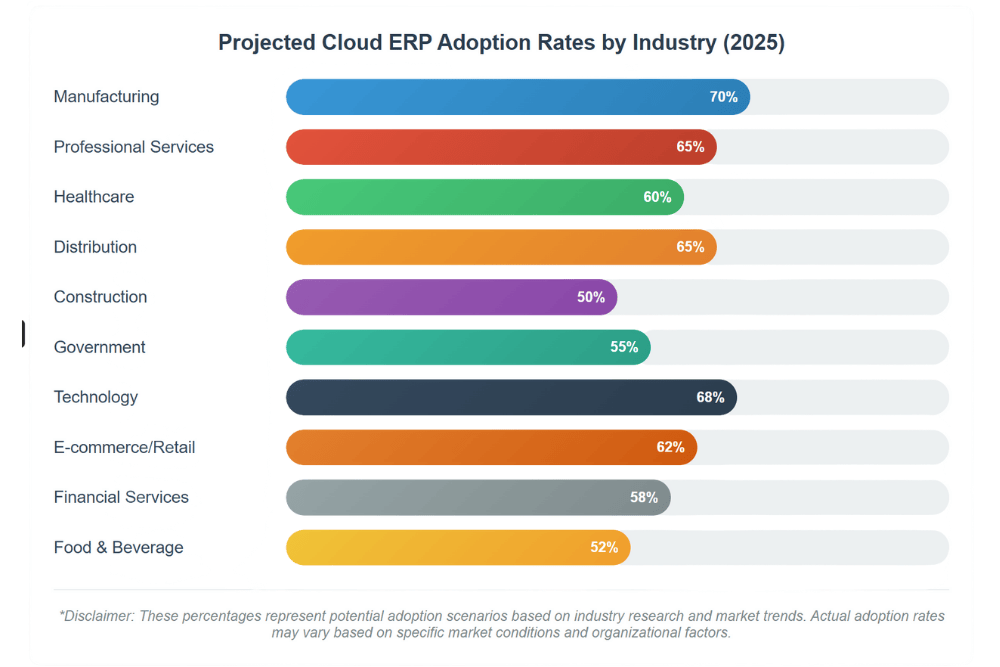
The data suggests that specific industries may experience particularly high cloud ERP adoption rates, with manufacturing and technology sectors potentially leading the way due to their complex operational requirements and need for real-time data integration.
Choosing the Right Cloud ERP Solution
When evaluating cloud ERP options, organizations should consider several key factors that may impact their success. Recent industry analysis show that that cloud ERPs are evolving into self-learning systems with advanced scenario modeling, hyper-automation capabilities, and enhanced fraud detection features.
Industry-Specific Functionality: Different ERP solutions offer varying levels of industry-specific features. Solutions like Sage 100, Sage 300, and Sage Intacct provide specialized functionality for different business needs and industry requirements.
Integration Capabilities: The ability to integrate with existing systems and third-party applications could significantly impact the overall value of a cloud ERP implementation. According to Panorama Consulting’s 2025 ERP trends research, organizations that adapt to emerging ERP trends gain competitive advantages through optimized efficiency and scalability.
Security and Compliance: Organizations in regulated industries should prioritize ERP providers that offer robust security measures and compliance certifications.
Scalability and Performance: Cloud ERP solutions should potentially accommodate future growth and changing business requirements without significant disruption.
Implementation Considerations
Successful cloud ERP implementation requires careful planning and consideration of industry-specific requirements. Organizations may want to evaluate factors such as:
Data migration complexity and timeline
User training and change management requirements
Integration with existing business applications
Ongoing support and maintenance needs
Our secure cloud services include managed server hosting, private server hosting, application hosting, and more. We customize our services to fit your company’s needs and offer critical support the moment you need it, demonstrating the importance of selecting a provider that can adapt to specific industry requirements.
The Future of Cloud ERP Across Industries
As we progress through 2025, cloud ERP adoption is likely to continue accelerating across all industries. Organizations that proactively embrace cloud ERP solutions may position themselves for enhanced operational efficiency, improved decision-making capabilities, and better competitive positioning.
The key to success lies in selecting the right combination of ERP software and hosting provider that understands your industry’s unique requirements and can deliver the security, reliability, and performance your organization needs.
Whether you’re considering QuickBooks Enterprise for growing businesses, Sage 100 for established companies, or Sage Intacct for organizations requiring advanced financial management capabilities, the potential benefits of cloud ERP implementation continue to make it an attractive option for forward-thinking organizations across all sectors.
By carefully evaluating your industry’s specific needs and selecting an experienced cloud ERP provider, your organization can potentially realize the full benefits of modern, cloud-based ERP solutions while maintaining the security and reliability critical to your business success.
Executive Summary Agentic AI is no longer a distant concept — it is actively entering enterprise resource planning (ERP) environments right now. Unlike passive automation or simple chatbots, agentic AI systems can plan, decide, and act across complex workflows with minimal human input. For businesses running cloud-hosted ERP software, this shift may represent one of […]
Executive Summary Intuit has confirmed significant price increases for QuickBooks Desktop products, effective February 1, 2026, or at each subscriber’s next renewal date. For finance leaders tracking software costs are already covering how these shifts affect budgeting decisions across small and mid-size businesses. At gotomyerp, we work with hundreds of companies navigating these exact changes […]
Deciding between QuickBooks hosting and QuickBooks Online isn’t always straightforward. While both solutions operate in the cloud, they function quite differently—and those differences matter when you’re running day-to-day operations. Gotomyerp has spent years helping businesses figure out which path makes sense for their specific needs, bringing enterprise-grade infrastructure to companies that want their accounting software […]