

Executive Summary
ERP software is splitting into two camps. One adds AI features on top of older designs. The other builds AI into the core, so agents can work on live data inside daily workflows.
That second group, often called AI-native ERP, is growing quickly. Gartner forecasts that spending on ERP software with agentic capabilities may reach $72 billion by 2030 [1].
For teams on older on-premises or desktop systems, timing and route matter most. A rushed migration can disrupt the close. Waiting too long may leave years of data where agents struggle to reach it.
This guide explains what AI-native ERP means, what it signals for legacy platforms, and three realistic paths forward. It also covers how CFO Tech helps finance leaders pick the path that fits their budget and risk.
5 Key Takeaways
- Gartner expects 40% of enterprise apps to embed task-specific AI agents by late 2026, up from under 5%. [2]
- Large firms are scaling agents fastest: 40% of $1B+ organizations report it, versus 22% of smaller ones. [3]
- Aging systems can carry outdated code, unsupported hardware, and known security gaps, according to federal auditors. [4]
- Gartner predicts over 40% of agentic AI projects could be canceled by 2027 over cost, value, or risk concerns. [5]
- Legacy ERP users have real options: managed cloud hosting, connected AI tools, or a phased move to cloud ERP.
What Is an AI-Native ERP?
An AI-native ERP is a finance and operations system designed with AI in its core architecture. Its agents work on live ledger data inside the same workflows people use to approve, post, and close.
Most AI-native platforms share five traits:
- One live data model. Agents read current transactions instead of nightly exports.
- Embedded agents. Matching, coding, and variance review can happen inside the workflow.
- Explainable outputs. Each recommendation shows the data and logic behind it.
- Role-based controls. Admins decide what agents can see, suggest, or execute.
- Continuous updates. New capabilities arrive through regular cloud releases.
The label is still debated. Startups often apply it to platforms built from scratch, while established vendors embed agents into proven cloud systems.
For buyers, the architecture matters more than the name.
AI-Native, AI-Enabled, and Legacy ERP at a Glance
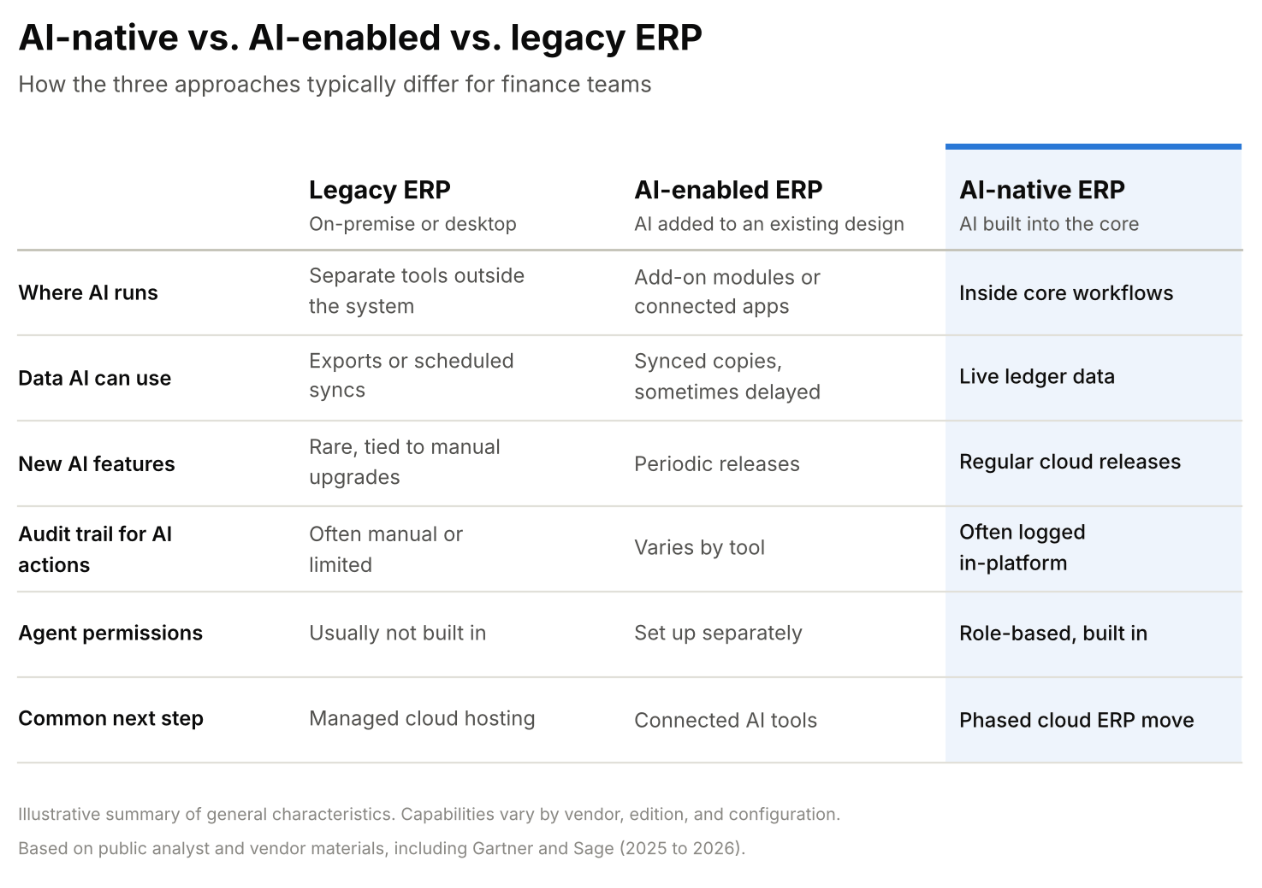
Disclaimer: This comparison shows general characteristics for illustration only. Actual capabilities vary by vendor, edition, and configuration. It does not assess any specific product or guarantee results.
Why AI-Native ERP Is Gaining Ground in 2026
Three forces are pushing AI deeper into finance systems this year.
Software is changing. Gartner predicts 40% of enterprise applications will feature task-specific AI agents by the end of 2026 [2]. Its ERP forecast points to a 74.6% five-year compound annual growth rate for agentic ERP spending [1].
Adoption is maturing. In McKinsey’s 2026 State of AI survey, 44% reported AI scaling across the enterprise, up from 38% [3].
Finance vendors are shipping agents. In April 2026, Sage announced its Finance Intelligence Agent for Sage Intacct [6]. Sage says every AI-driven action is logged, creating an audit trail of recommendations and approvals.
AI Agents Are Arriving Faster Than Most Teams Can Scale Them
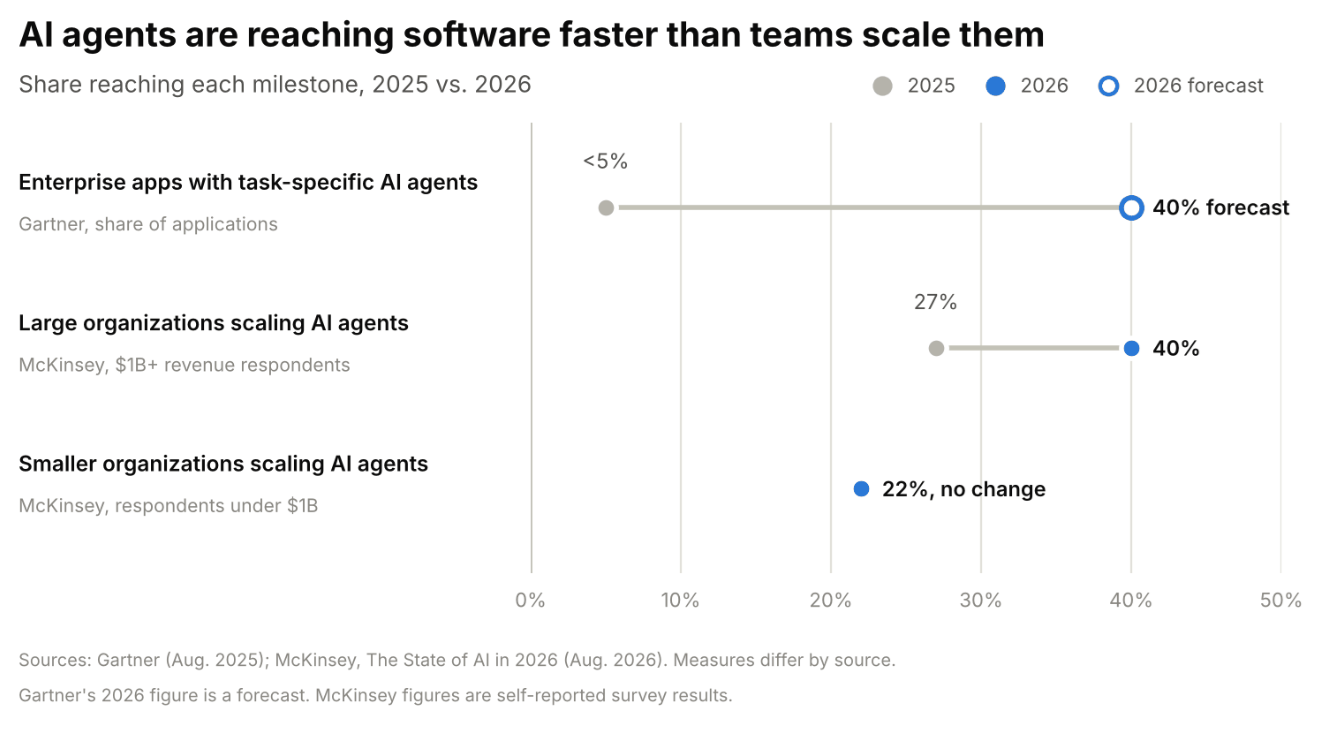
Disclaimer: This chart summarizes published third-party forecasts and self-reported survey results. Gartner measures applications, while McKinsey measures survey respondents. Forecasts may change, and figures do not guarantee any organization’s outcomes.
That gap matters. McKinsey found only about 6% of respondents qualify as AI high performers, unchanged from 2025 [3]. Nearly three in four of those leaders redesigned workflows around AI, compared with about one in four others.
What AI-Native ERP Means for Legacy Systems
Legacy ERP will not disappear overnight. Many companies still run reliable on-premises or desktop accounting systems with years of clean history. The pressure tends to show up in quieter ways.
- Data access. Agents need current, connected data, which a single office server may not expose.
- Upgrade cadence. New AI features often reach cloud platforms first. Older versions may get them later, or never.
- Skills and support. Fewer specialists may know older code, custom scripts, and aging integrations.
- Security exposure. Unsupported components can leave known vulnerabilities open longer.
Federal agencies show how this can compound. A GAO review of 11 critical legacy systems found eight used outdated languages and seven had known vulnerabilities [4]. GAO notes agencies typically report spending about 80% of IT budgets on operating and maintaining existing systems.
Mid-sized businesses face a smaller version of the same math. Budget spent patching an aging server is budget unavailable for forecasting or automation.
Sage’s own direction is worth watching too. Its expanded collaboration with AWS includes speeding customer moves from traditional desktop products to cloud solutions [7].
Three Practical Paths for Legacy ERP Users
No single answer fits every company. The right path depends on your data quality, your team, and how much change your close calendar can absorb.
Path 1: Stabilize Your Current ERP in a Managed Cloud
Hosting Sage 100, Sage 300, or QuickBooks Desktop in a managed cloud can remove server headaches quickly. Users can keep familiar screens and reports while gaining secure remote access. This path may buy time while you plan a larger move.
Path 2: Extend Legacy ERP With Connected AI Tools
Some teams add AI through integrations for invoice capture, bank feeds, or reporting. These tools can deliver real wins on a modest budget. Data often syncs on a schedule, though, so insights may lag behind the ledger.
Path 3: Move to a Cloud ERP With Embedded AI Agents
Growing, multi-entity, or reporting-heavy teams may see the most upside from a phased move. Embedded agents can work on live data with built-in permissions and audit trails. Migration still takes clean data, training, and a well-timed cutover.
CFO Tech supports all three paths, from hosting to integrations to Sage implementation. So the advice follows your situation.
Where Sage Intacct Fits in the AI-Native Shift
Sage Intacct is a cloud financial platform, so new AI capabilities can reach users through regular releases. Its R1 2026 release added Close Analytics, Cash Intelligence, AI line-level matching, and an AI-powered Import Agent [8].
These tools work alongside existing Close, AP, Time, and Assurance Agents [8]. The Finance Intelligence Agent, rolling out in phases, lets teams ask plain-language questions about their data [6]. People keep final decision authority, and each recommendation explains its underlying data and logic.
Seeing these agents in familiar scenarios often answers questions a feature list cannot. A guided Sage Intacct demo can show how close, cash, and AP workflows might look for your entities.
How Should Finance Leaders Evaluate an AI-Native ERP?
These seven steps can help you avoid expensive detours:
- Define the outcome first. Pick one or two goals, such as a faster close or clearer cash visibility.
- Test for real agents. Gartner warns that many vendors rebrand chatbots as agents, a practice it calls agent washing [5]. Ask for live demos on realistic data.
- Demand explainability. Each recommendation should show its source data and reasoning.
- Review access controls. IBM’s 2026 breach research found 92% of organizations with AI-related breaches lacked proper AI access controls [9].
- Plan for shadow AI. IBM also reports shadow AI incidents rose from 20% to 43% of breached organizations.
- Use a governance framework. The NIST AI Risk Management Framework offers voluntary guidance for managing AI risk [10].
- Phase the rollout. Start with one entity or process, measure results, then expand.
Frequently Asked Questions
What is the difference between AI-native and AI-enabled ERP?
AI-native ERP builds AI into its core data model and workflows. AI-enabled ERP adds AI features to an existing design, sometimes through separate tools.
Is legacy ERP becoming obsolete?
Not necessarily. Many legacy systems remain dependable for core accounting. Over time, though, they may limit access to newer AI capabilities.
Can Sage 100 or Sage 300 users benefit from AI?
Often, yes. Cloud hosting and integrations can extend these systems. Sage’s newest finance agent, the Finance Intelligence Agent, is being released for Sage Intacct [6].
How long does a move to AI-native ERP take?
Timelines vary widely. A focused, single-entity project may take a few months. Multi-entity or heavily customized moves usually take longer.
Are AI agents safe to use with financial data?
They can be, with the right controls in place. Look for role-based permissions, explained recommendations, logged actions, and human approval steps.
Ready to See AI-Native Finance on Your Own Data?
AI-native ERP is raising the bar for what finance systems can do. Legacy platforms still have a place, and the best next step is one you choose with clear evidence.
CFO Tech can help you compare hosting, integration, and migration options side by side. Request a free test drive to book a live demo around one real workflow, like your month-end close. Then watch how an AI-native ERP might handle it, step by step.
Key References and Sources
- Source [1]: Gartner. (2026). “Forecast Analysis: Agentic AI in ERP Software, 2026.” Retrieved from https://www.gartner.com/en/documents/7408830
- Source [2]: Gartner. (2025). “Gartner Predicts 40% of Enterprise Apps Will Feature Task-Specific AI Agents by 2026, Up from Less Than 5% in 2025.” Retrieved from https://www.gartner.com/en/newsroom/press-releases/2025-08-26-gartner-predicts-40-percent-of-enterprise-apps-will-feature-task-specific-ai-agents-by-2026-up-from-less-than-5-percent-in-2025
- Source [3]: McKinsey & Company. (2026). “The State of AI in 2026: On the Road to ROI.” Retrieved from https://www.mckinsey.com/capabilities/quantumblack/our-insights/the-state-of-ai
- Source [4]: U.S. Government Accountability Office. (2025). “Information Technology: Agencies Need to Plan for Modernizing Critical Decades-Old Legacy Systems.” Retrieved from https://www.gao.gov/products/gao-25-107795
- Source [5]: Gartner. (2025). “Gartner Predicts Over 40% of Agentic AI Projects Will Be Canceled by End of 2027.” Retrieved from https://www.gartner.com/en/newsroom/press-releases/2025-06-25-gartner-predicts-over-40-percent-of-agentic-ai-projects-will-be-canceled-by-end-of-2027
- Source [6]: Sage. (2026). “Sage Expands AI Agents Across Finance, HR and Operations to Automate Workflows and Help Teams Act Faster With Control.” Retrieved from https://www.sage.com/en-us/news/press-releases/2026/04/sage-expands-ai-agents-across-finance-hr-and-operations-to-automate-workflows/
- Source [7]: Sage. (2026). “Sage Deepens Collaboration With AWS to Fast-Track Agentic AI for Small and Mid-Sized Businesses.” Retrieved from https://www.sage.com/en-us/news/press-releases/2026/04/sage-deepens-collaboration-with-aws-to-fast-track-agentic-ai-for-small-and-mid-sized-businesses/
- Source [8]: Sage. (2026). “Sage Intacct Delivers New AI-Powered Capabilities to Transform How Finance Teams Close, Analyze, and Act on Financial Data.” Retrieved from https://www.sage.com/en-us/news/press-releases/2026/02/sage-intacct-delivers-new-ai-powered-capabilities-to-transform-how-finance-teams-close/
- Source [9]: IBM. (2026). “Cost of a Data Breach Report 2026.” Retrieved from https://www.ibm.com/reports/data-breach
- Source [10]: National Institute of Standards and Technology. (2023). “AI Risk Management Framework.” Retrieved from https://www.nist.gov/itl/ai-risk-management-framework
Disclaimer
This article is for general informational and educational purposes only. It does not constitute financial, legal, accounting, tax, cybersecurity, or technology implementation advice. Statistics, forecasts, and product details come from third-party sources believed accurate at publication and may change. Forecasts are estimates and do not guarantee future results. Charts are illustrative or summarize third-party data and do not represent measured outcomes for any CFO Tech client. Vendors set product features, availability, and release timing, which may vary by edition and region. CFO Tech makes no guarantee of specific results, savings, timelines, or security outcomes from any software or service described. Please consult qualified professionals before making business or technology decisions. All trademarks and product names belong to their respective owners.